

Throughout the established neighborhoods of Greater Houston—including River Oaks, West University, Meyerland, Spring Branch, and Pasadena—thousands of homes constructed prior to the mid-1980s rely on subterranean cast iron drain-waste-vent (DWV) piping. While cast iron was celebrated for its sound-dampening qualities and rigid structural strength in mid-century construction, it possesses a severe, predictable biochemical vulnerability that standard visual home inspections cannot detect.
1. The Chemical Process of Bottom "Channelling"
Unlike copper or plastic pipes, cast iron does not fail primarily from external soil contact. Failure initiates internally through a chemical reaction between anaerobic sewer bacteria, organic waste, and stagnant water. As wastewater decomposes, bacteria release hydrogen sulfide gas (H2S). When moisture vapor condenses along the upper pipe wall, the gas dissolves into water droplets, forming dilute sulfuric acid (H2SO4).
As this acidic solution runs down the sidewalls and pools along the bottom invert of the pipe, it relentlessly corrodes the cast iron. Over 40 to 60 years, the bottom 1/4 inch of solid metal dissolves into iron oxide scale. Eventually, the entire bottom of the pipe vanishes—a catastrophic condition known as "channelling." At this stage, wastewater flows directly across bare dirt beneath your home's foundation slab.
2. Soil Erosion, Voids, and Foundation Collapse
In Houston's hyper-reactive black gumbo clay, channeled cast iron pipes trigger catastrophic foundation movement. As pressurized drainage water saturates the soil beneath the slab, the clay expands violently, causing localized foundation heaving. Conversely, when the leak washes soil into municipal storm sewers, massive underground voids develop. Deprived of subgrade support, the concrete slab cracks and sinks under the weight of the structure.
3. What High-Definition Sewer Scopes Uncover
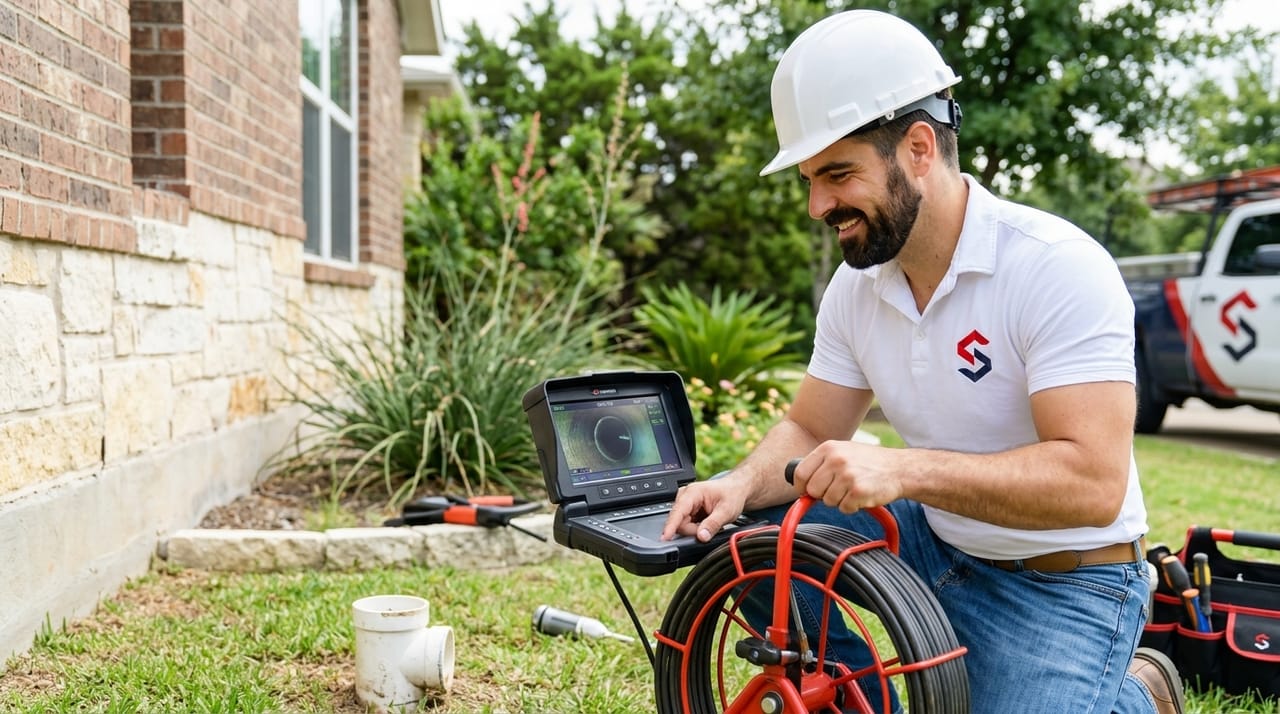
TREC Standard of Practice §535.231 only requires inspectors to operate visible plumbing fixtures and observe whether water drains. A home with collapsed pipes can easily pass a visual inspection if toilets flush and sinks drain during a 15-minute walkthrough. Secured Inspections deploys self-leveling, fiber-optic color cameras (Ridgid SeeSnake®) equipped with 512Hz sondes to trace the exact underground path:
- Severe Exfoliation & Scale: Flaking layers of rusted cast iron that catch toilet paper and solid waste, causing recurrent sewer clogs.
- Invert Fractures & Missing Pipe Sections: Clear video evidence showing water carving trenches into raw soil where pipe metal has dissolved.
- Tree Root Intrusion: Live oak and pine roots penetrating hub joints and fractures, completely occluding the pipe lumen.
- Pipe Bellies (Standing Water): Low spots caused by clay soil shifting where water and sludge permanently pool, indicating loss of gravitational fall.
4. Replacement Economics: Tunneling vs. Trenchless Lining
When failed cast iron is confirmed beneath a slab, homeowners face two expensive remediation paths. Traditional under-slab tunneling requires hand-excavating tunnels 3 to 5 feet beneath the home to hang new PVC pipes, costing $350 to $500 per linear foot. Alternatively, cured-in-place pipe (CIPP) epoxy relining costs $150 to $250 per foot but requires sufficient host pipe integrity to anchor the liner. Knowing these numbers during your Option Period provides unbeatable closing credit leverage.
Need an Objective Forensic Property Inspection?
Residential Pre-Purchase, ASTM E2018 Commercial PCAs, Termite WDI, Sewer Camera Scopes, and FLIR Thermal Infrared diagnostics across Greater Houston, Galveston, and Brazoria.
