

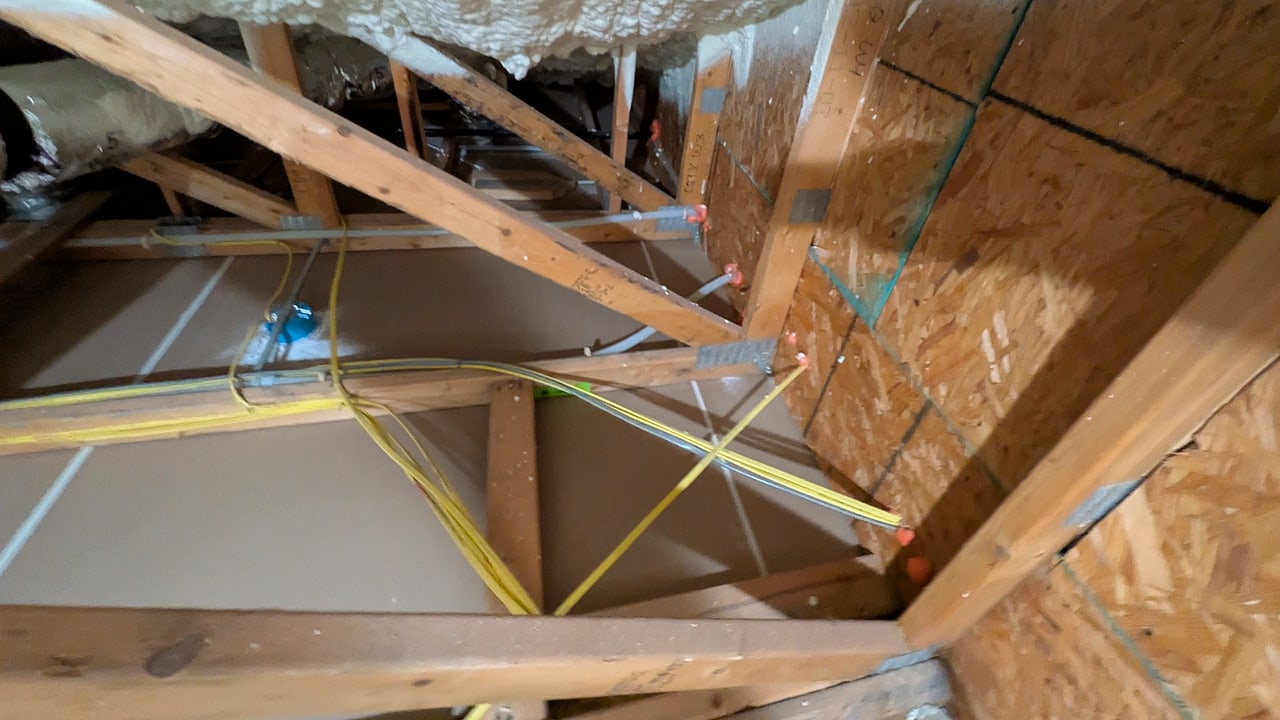
Throughout the booming suburban master-planned communities of Greater Houston—including Cypress, Fulshear, Conroe, Iowa Colony, and Tomball—hundreds of new production and custom homes are constructed monthly. Many buyers assume that because a home is "brand new" and subject to city code inspections, an independent home inspection is unnecessary. In our forensic field experience, pre-drywall phase inspections uncover more severe structural defects than almost any other category.
1. The Fast-Track Production Building Reality
Modern production builders operate on rapid construction timelines. Framing crews, plumbing subcontractors, electrical teams, and HVAC installers work under intense piece-rate deadlines. When a plumber needs to run a 3-inch drain line or an HVAC crew needs to route a 12-inch flexible duct, they frequently cut through structural engineered wood I-joists, notch load-bearing wall studs, or remove truss bracing without consulting the structural engineer of record.
2. Top Deficiencies Uncovered During Pre-Drywall Inspections
Secured Inspections conducts exhaustive 300-point pre-drywall audits against the International Residential Code (IRC) and manufacturer installation manuals:
- Over-Bored or Notched Load-Bearing Studs (IRC R602.6): Holes bored in exterior load-bearing studs cannot exceed 40% of the stud width (60% if doubled). We routinely catch tradesmen cutting 80% through structural 2x4 studs.
- Engineered I-Joist Web Breaches: Holes cut too close to bearing supports or through joist top and bottom chords destroy floor load-carrying capacity, resulting in sagging second floors.
- Missing Structural Hardware & Hurricane Straps: Verifying all Simpson Strong-Tie clips, hold-downs, anchor bolts, and rafter ties are fully nailed with specified structural fasteners rather than missed nail holes.
- Fire-Blocking and Draft-Stopping Omissions (IRC R302.11): Missing 2-inch solid lumber or fire-rated foam at ceiling-to-attic penetrations, drop soffits, and double-stud party walls that would otherwise allow fire to spread rapidly into attics.
- Plumbing Nail Plates: Missing 16-gauge steel safety striker plates wherever water pipes pass within 1-1/4 inches of a stud face, leaving pipes vulnerable to drywall screw punctures.
Residential Building Science & TREC Standards of Practice
A certified residential home inspection is a rigorous evaluation of interconnected building systems. Under the Texas Real Estate Commission (TREC) Standards of Practice (§§535.227–535.233), Secured Inspections executes a systematic forensic protocol across all major home components:
- Structural Envelope & Elevation Survey: Auditing foundation slabs, crawlspace framing, exterior masonry weep screeds, roof trusses, and attic ventilation using digital altimeters and thermal imaging to detect active movement and moisture intrusion.
- Electrical Life-Safety Diagnostics: Verifying arc-fault circuit interrupter (AFCI) and ground-fault circuit interrupter (GFCI) trip response, main service grounding electrode bonding, panelboard temperature gradients, and branch wiring integrity.
- Mechanical HVAC & Indoor Air Quality: Testing sensible and latent cooling split differentials, condensate drainage safety float switches, combustion air supplies, gas furnace heat exchangers, and ductwork insulation R-values.
- Plumbing Supply & Drainage Pressure Testing: Checking static water pressure, thermal expansion tanks, water heater temperature-pressure relief (TPR) discharge lines, fixture flow, and waste drainage performance.
By delivering comprehensive, clear, and data-driven inspection reports, our forensic team ensures prospective Texas homeowners possess complete clarity regarding property condition before removing contractual contingencies.
Need an Objective Forensic Property Inspection?
Residential Pre-Purchase, ASTM E2018 Commercial PCAs, Termite WDI, Sewer Camera Scopes, and FLIR Thermal Infrared diagnostics across Greater Houston, Galveston, and Brazoria.
