
In the expanding industrial submarkets of Northwest Houston, Baytown, and Missouri City, distribution centers and manufacturing facilities place extraordinary mechanical demands on interior concrete floor slabs. When acquiring an industrial facility, evaluating the structural integrity, load-bearing capacity, and surface tolerances of the concrete slab is paramount to safeguarding capital investment and tenant operations.
1. Floor Flatness (FF) and Floor Levelness (FL) Standards
Modern high-bay warehouses utilize narrow-aisle (VNA) forklifts operating at mast heights of 25 to 40 feet. Under ASTM E1155, floor profiles are quantified using two distinct numerical parameters: Floor Flatness (FF), which measures bumpiness and curvature over a 12-inch baseline, and Floor Levelness (FL), which measures overall slope across a 10-foot span.
Even minor un-levelness or surface irregularities amplify dramatically at mast heights. A 1/8-inch elevation variance at the slab surface can produce 3 to 5 inches of lateral mast sway at the rack top, leading to dangerous rack strikes, dropped inventory, and severe worker safety hazards.
2. Construction Joint Spalling and Wheel Impact Failure
Industrial forklifts utilize hard polyurethane or solid rubber tires that exert ground contact pressures exceeding 500 to 1,000 psi. When control joints or expansion joints are left unfilled or have lost their semi-rigid epoxy/polyurea joint fillers, wheel impact continuously crushes the un-backed concrete edges. This phenomenon, known as joint spalling, widens rapidly, creating jagged potholes that destroy forklift axle assemblies and break palletized merchandise.
3. Subbase Settlement & High-Plasticity Houston Clay
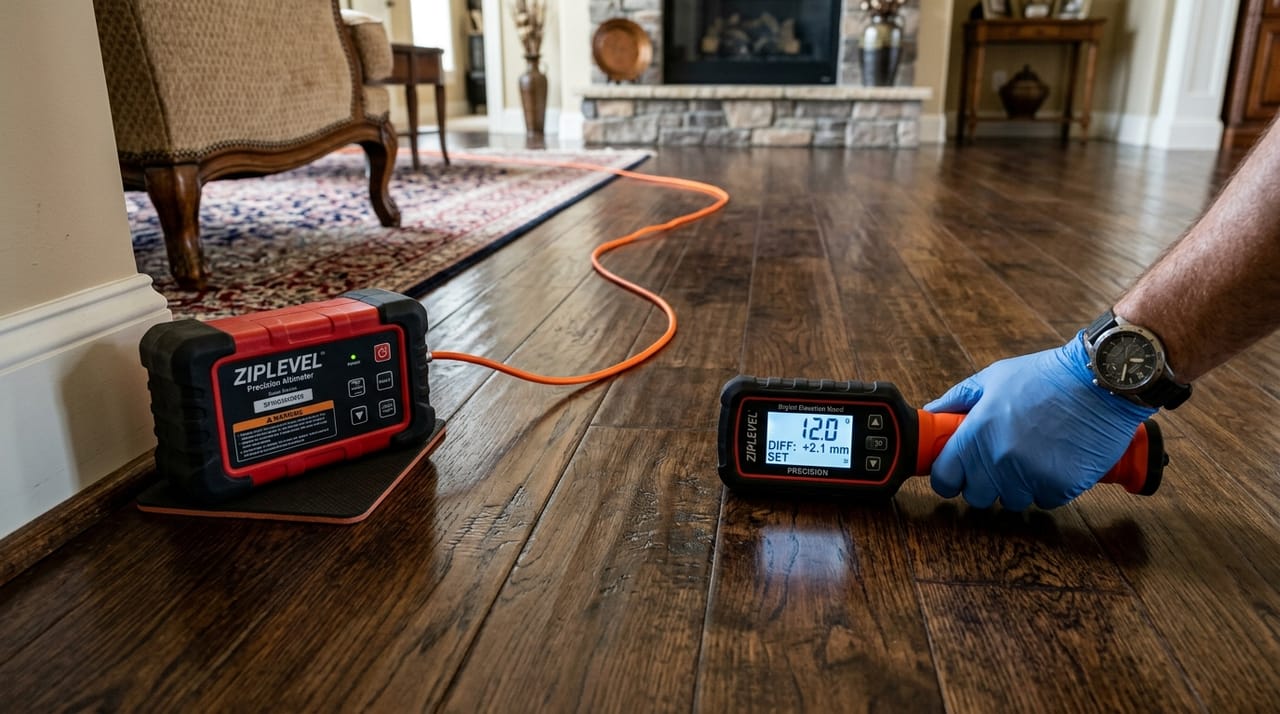
The geological subgrade across Greater Houston consists of highly expansive Beaumont formation clay. In poorly prepared industrial building pads where moisture conditioning or chemical lime stabilization was insufficient, subbase settlement produces severe differential slab deflection across building column grids. Secured Inspections utilizes precision digital manometers (ZipLevel®) to record elevation contours across warehouse bays, verifying whether settlement exceeds acceptable 1:360 structural deflection limits.
4. Racking Anchor Bolt Pull-Out and Post-Tensioned Tendons
When tenants install heavy structural racking systems, wedge anchor bolts are drilled 4 to 6 inches into the slab. In post-tensioned (PT) industrial slabs, striking an unbonded tendon with a rotary hammer drill can cause cataclysmic tendon rupture, snapping the high-strength steel cable through the concrete and destroying slab tension. Our PCA inspections verify whether past tenant racking anchors severed rebar or tendon lines and whether proper GPR (ground-penetrating radar) scanning protocols were observed.
5. ASTM E2018-24 Field Verification Protocol
Conducting a forensic property condition assessment along the Texas Gulf Coast requires methodical field procedures. Secured Inspections integrates multi-point non-destructive verification across all structural, mechanical, and envelope systems:
- Historical Municipal Permit Discovery: Reviewing local building department records for unpermitted commercial alterations, historical tenant buildouts, and prior structural repairs.
- Physical Asset Life-Cycle Auditing: Recording equipment serial plates, manufacturer model numbers, and nameplate capacities to cross-reference against national replacement databases and ASHRAE service baselines.
- Environmental & Life-Safety Cross-Check: Verifying clear egress pathways, emergency battery backup lighting systems, backflow prevention certifications, and Americans with Disabilities Act (ADA) architectural barrier compliance.
- Comprehensive Capital Reserve Forecasting: Tabulating immediate physical deficiencies versus long-term 10-year capital expenditure (CapEx) schedules to equip commercial buyers and institutional lenders with actionable financial models.
By combining rigorous visual observation with engineering-backed cost estimating, our commercial condition surveys provide the factual clarity required to negotiate substantial purchase price adjustments or required escrow reserves prior to the expiration of your contractual feasibility period.
Need an Objective Forensic Property Inspection?
Residential Pre-Purchase, ASTM E2018 Commercial PCAs, Termite WDI, Sewer Camera Scopes, and FLIR Thermal Infrared diagnostics across Greater Houston, Galveston, and Brazoria.
