
When executing due diligence on commercial real estate throughout Greater Houston, Harris County, and the Texas Gulf Coast, low-slope roof assemblies represent one of the most volatile capital expenditure (CapEx) liabilities an investor can inherit. Unlike residential steep-slope shingle roofs, commercial flat roof systems—primarily Thermoplastic Polyolefin (TPO), Ethylene Propylene Diene Monomer (EPDM), and multi-ply Modified Bitumen—operate under extreme environmental stressors including intense ultraviolet exposure, tropical storm wind-uplift pressures, and severe ponding water.
1. The Physics of Low-Slope Failure in the Texas Climate
Commercial buildings along the Gulf Coast endure rapid thermal cycling. On a typical 98°F summer day in Pasadena or Beaumont, a dark modified bitumen roof surface can reach temperatures exceeding 165°F. Sudden afternoon thunderstorms induce thermal shock, rapidly contracting roof membranes, flashing collars, and parapet coping caps. Over 5 to 7 years, this expansion-contraction hysteresis causes plasticizer migration in inferior PVC membranes, seam delamination in EPDM systems, and embrittlement along TPO heat-welded joints.
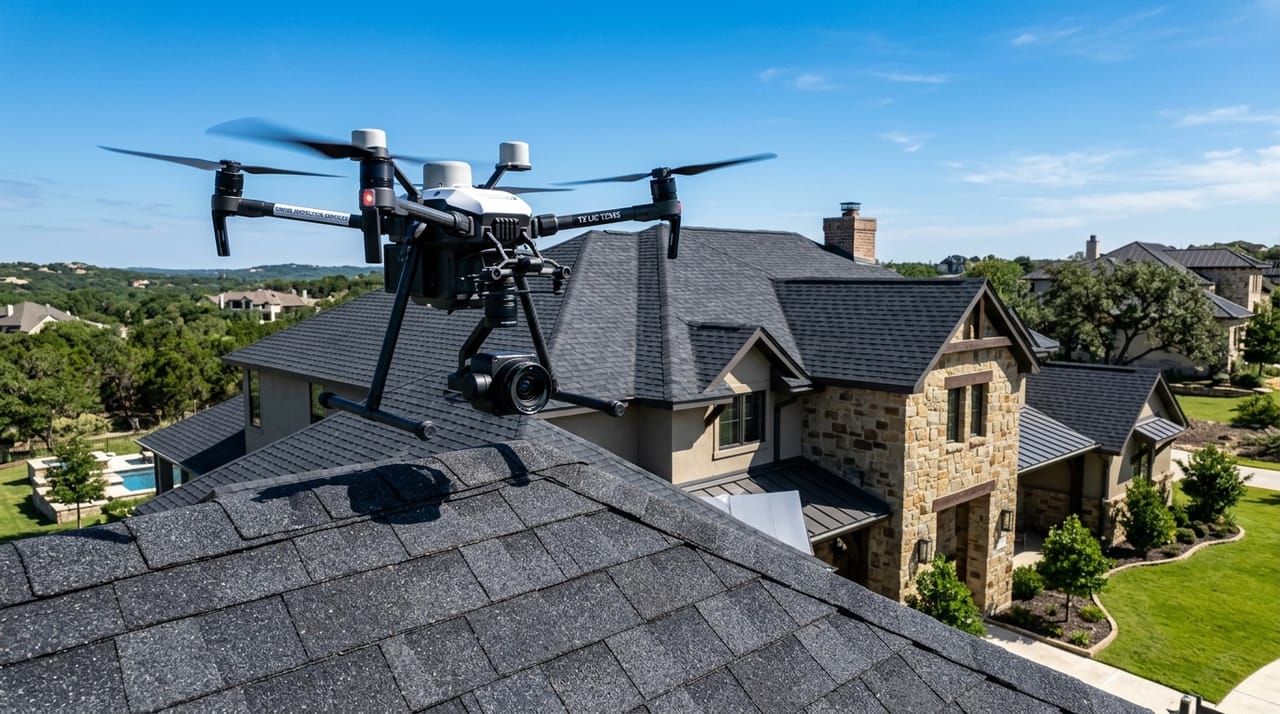
Under ASTM E2018-24 Standard Guide for Property Condition Assessments, a qualified forensic baseline evaluation requires direct physical observation of the membrane, drainage infrastructure, penetrations, and perimeter edge metal flashing. Secured Inspections combines walking field inspections with high-resolution aerial drone thermography to detect subsurface moisture pockets invisible to the naked eye.
2. TPO Membrane Forensics: Probing Heat-Welded Seams
TPO currently dominates new commercial construction in Texas due to its initial cost-efficiency and solar reflectance index (SRI). However, its long-term performance hinges entirely on the quality of hot-air robotic or hand welding during installation. During our commercial PCA inspections, our team performs systematic seam probing across 100% of accessible perimeter transitions and field splices:
- Cold-Weld Voids: Insufficient nozzle temperature or rapid machine travel creates unbonded "cold welds" that appear intact visually but separate under minimal mechanical shear force.
- Substrate Backer Crushing: Polyisocyanurate (polyiso) insulation boards beneath the TPO membrane can crush under repeated rooftop HVAC service foot traffic, creating localized depressions that collect stagnant rainwater.
- Ultraviolet Degradation & Chalking: First-generation TPO formulations frequently suffer surface crazing and micro-fissures around unshaded mechanical curbs where reflected heat accelerates compound breakdown.
3. EPDM & Modified Bitumen Assemblies: What to Watch For
While less common in new Texas construction, thousands of commercial strip centers and industrial flex parks constructed between 1985 and 2010 utilize black EPDM rubber or granule-surfaced modified bitumen systems. In EPDM installations, failure rarely occurs in the cured sheet itself; rather, failure concentrates in adhesive seam tapes that undergo chemical breakdown under standing water.
For modified bitumen and built-up roofing (BUR), inspectors audit for alligatoring, fish-mouth delaminations at lap joints, and blistering caused by trapped moisture vaporizing under high solar radiation. If blisters have broken and exposed the underlying fiberglass or polyester reinforcement mat, immediate cap sheet recoating or localized torch-applied repairs are required.
4. Drainage Infrastructure & The 48-Hour NRCA Standard
The National Roofing Contractors Association (NRCA) and International Building Code (IBC) Section 1507 mandate that low-slope roofs be designed with positive drainage (minimum 1/4 inch per foot slope) to eliminate standing water within 48 hours of rainfall. Along the flat topography of the Texas coastal plain, structural deflection of steel purlins or precast concrete double-T beams frequently causes severe ponding.
Standing ponding water creates a destructive feedback loop: water weight increases structural deflection, attracting more rainwater. A 1-inch deep pool covering a 20x20 foot bay adds over 2,000 pounds of unanticipated dead load to structural bar joists while simultaneously creating algae slicks that deteriorate asphaltic adhesives.
5. Parapet Flashing and Coping Joint Verification
Over 70% of commercial roof leaks audited by Secured Inspections originate not in the open field membrane, but at perimeter terminations. Parapet wall coping metal must feature continuous cleats, watertight standing seams, and high-performance elastomeric sealants. Missing kickout diverters, unsealed counter-flashings along masonry facades, and improper pitch-pocket filler allow moisture to migrate down interior cavity walls, rotting steel studs and triggering toxic mold blooms.
Need an Objective Forensic Property Inspection?
Residential Pre-Purchase, ASTM E2018 Commercial PCAs, Termite WDI, Sewer Camera Scopes, and FLIR Thermal Infrared diagnostics across Greater Houston, Galveston, and Brazoria.
